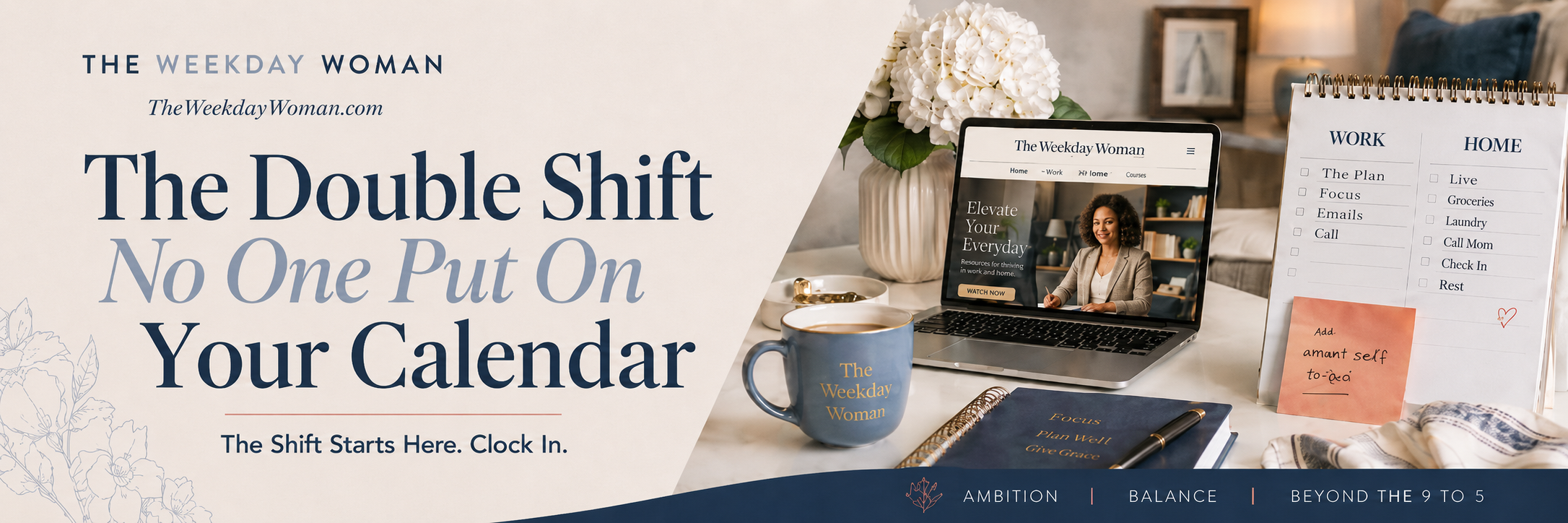
You didn't apply for the second job. There was no interview, no offer letter, no onboarding. One day you simply noticed you were the person who knew when the dog was due for shots, which kid would not eat the sandwich cut the wrong way, when your mother's cardiology appointment was, and whether anyone had bought milk. Congratulations. You've been promoted to Default Everything. The pay is often terrible.
This is the double shift, and the data has finally caught up to what you've been living for years.
The numbers you already knew in your body
In 2025, 73.9% of mothers with children under 18 were in the U.S. labor force, according to the Bureau of Labor Statistics. Read that again. Most moms are not choosing between earning a paycheck and running a household. They are doing both, often before 9 a.m., usually while finding someone's other shoe.
And "mom" badly undersells the load. Caregiving does not check whether your dependents are small and adorable. The 2025 Caregiving in the U.S. report from AARP and the National Alliance for Caregiving counts 63 million family caregivers — roughly one in four American adults — and nearly a third of them are "sandwich generation," holding up a child and an adult at the same time. Picture it: spreadsheet open, science fair due Friday, and your dad's pharmacy on hold.
Caregiving is not a warm feeling. It is logistics. Transportation, medication, paperwork, scheduling, advocacy, and the 11 p.m. symptom-Googling you wish you didn't have to do. It is a full unpaid job stacked on a paid one — and the unpaid one doesn't promote you, doesn't clock out, and doesn't care that you have a 10 a.m.
"But the calendar looks even"
This is where people get it wrong. Your shared calendar may look like a tidy fifty-fifty. Your actual week does not feel like one, and the Federal Reserve agrees with you.
The Fed's 2025 report on household economic well-being found care work still falls disproportionately on women. Among partnered parents of young children, 58% of mothers said they were usually the primary caretaker when the kids were home — versus 12% of fathers. In dual-earner couples, where the math really should even out, it was 49% of working mothers and 8% of working fathers.
You can be the default parent, planner, scheduler, nurse, and emotional help desk and still have a calendar that "looks balanced." Mental load doesn't show up in time blocks. It shows up at 2 a.m., when you remember the permission slip.
Caregiving does not respect office hours
It interrupts the meeting. It moves the deadline. It eats the sleep you were saving for yourself. The AARP and National Alliance for Caregiving 2025 findings report that 61% of family caregivers say their work life takes a hit — and 61% of those caregivers are women.
So, no. You are not "bad at time management." You are a competent person being asked to run four systems on the resourcing of one. That is not a personal flaw, and the distinction is not academic. You cannot strategize your way out of a problem you've been trained to call a character defect.
Why we don't do "Sunday Scaries" here
The wellness internet would like to sell you the Sunday Scaries and a tidy little TGIF. Charming. Except your week may not start on Monday and may not end on Friday. Your shift might begin at 7 p.m., or 11 p.m., or Saturday at dawn — whenever someone else's need quietly becomes your responsibility. If you work three twelves, graveyards, weekends, holidays, travel, or two jobs and a care calendar, the standard-workweek story was never written about you.
At The Weekday Woman, the double shift is precisely this: the paid labor and the unpaid labor you carry across the entire rhythm of your life. You clock out of one job and clock straight into the next. We are not going to insult you by suggesting a bath bomb closes that gap.
What you actually need — and it is not "balance better"
You do not need to be told to balance better. "Balance" is mostly what we call it when we want a woman to fix an unfair distribution by trying harder and complaining less.
What moves the needle is less inspirational and more concrete: honest conversations at home about who owns what, not just who "helps"; workplaces that treat caregiving as a fact of adult life rather than a scheduling inconvenience; flexible policy and paid leave; planning systems built for your real week instead of a fictional one; community, respite, and financial planning that accounts for the care you give for free; and permission — loud, explicit, on-the-record permission — to stop measuring your worth by how much you can carry without mentioning it.
This is not only a family matter. The same Fed report tied childcare responsibilities directly to whether women work at all: among parents of children under 13, 37% of mothers were not working for pay compared with 18% of fathers, and 41% of non-working mothers said childcare was at least part of the reason. That is not a household footnote. That is an entire economy quietly running on women's unpaid hours and hoping no one does the math.
The part we want you to keep
The woman carrying the double shift is not lazy. She is not scattered. She is not failing. She is, far more often, over-functioning inside a system that decided her exhaustion was normal and then stopped asking about it.
The work no one sees still counts. The care still counts. And your strength was never meant to be the reason no one offered to help.
The shift is real. The care is real. And you — the one who has been holding all of it together — deserve support that is just as real.
Ready for the shift of your life? Clock in. | TheWeekdayWoman.com/Freebie